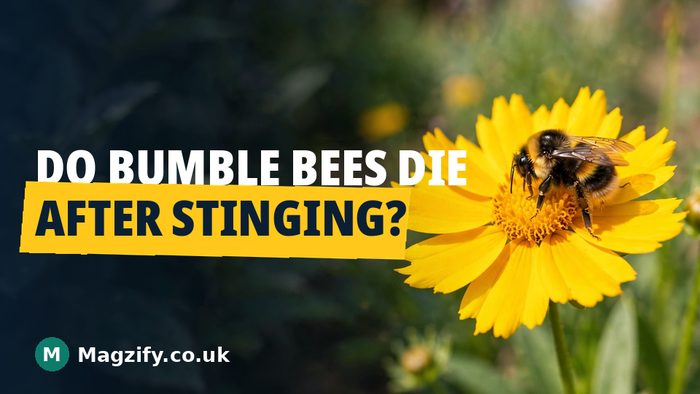
No, bumble bees do not die after stinging. Their stinger is smooth, so it slides out cleanly and the bee flies away. Only honeybees die, because their barbed stinger tears free.
Key takeaways
- Bumble bees survive and can sting more than once.
- Honeybees die after stinging people.
- Only females can sting; males cannot at all.
- They sting only in self-defence, usually near the nest.
- Wash, apply a cold compress, watch for allergy signs.
Do Bumble Bees Die After Stinging?
No. The smooth stinger pierces the skin, delivers venom and withdraws intact. The bee keeps its stinger, flies off unharmed, and could sting again if still threatened.
Why Do Honeybees Die but Bumble Bees Don’t?
A worker honeybee’s stinger is barbed like a harpoon. In thick human skin it lodges fast; when the bee pulls away, the stinger rips out with part of the abdomen and the bee dies within hours. Biologists call this autotomy: self-sacrifice that protects the hive, since the detached stinger keeps pumping venom.
Bumble bee colonies are small (a few hundred bees) and annual, so this kamikaze defence never evolved in them. Their smooth stinger is the ancestral design; the honeybee’s barbs are the exception, not the rule.
Can Bumble Bees Sting More Than Once?
Yes, because the stinger is never lost. In practice they almost never sting twice: bumble bees are docile pollinators that prefer to retreat, reserving the sting for direct threats like a disturbed nest or being trapped in clothing.
Do Male Bumble Bees Sting?
No. The stinger is a modified egg-laying tube (ovipositor), so male drones have none and cannot sting no matter how boldly they hover. A big fuzzy bee investigating you closely is often a harmless male.
Bumble Bee Behaviour: Why They Rarely Sting
Bumble bees are foragers, not guards. Unlike honeybees with honey stores to defend, or wasps defending nests aggressively, bumble bees have little worth dying for and act accordingly. They warn first with loud buzzing and darting flights.
Most UK stings happen when someone steps on a ground nest (often in lawns or compost heaps), sits on a bee, or traps one in clothing. Swatting provokes them; staying still or moving away slowly almost always ends the encounter.
UK Bumblebees You Might Meet
The buff-tailed bumblebee is the big familiar one, out almost all year. The red-tailed bumblebee (black with a red tail) and white-tailed bumblebee are common in gardens. All 24-odd UK species share the smooth stinger and gentle temperament.
When Do Bumble Bees Sting People?
In self-defence: near a ground nest, handled roughly, or trapped against skin. Give warning buzzing respect and back off.
What To Do After a Sting
Wash with soap and water, apply a cold compress for 10 to 15 minutes, and use antihistamine cream for itching. Pain usually fades within a few hours. Unlike honeybee stings, there is no stinger to scrape out.
Seek urgent help for breathing difficulty, face or throat swelling, rapid heartbeat or dizziness: signs of anaphylaxis. Anyone with a known venom allergy should carry an adrenaline auto-injector.
Bumble Bees vs Honeybees vs Wasps
Bumble bees are large, furry and round, living in small annual colonies. Honeybees are slimmer, less hairy, and live in large perennial hives with tens of thousands of workers. Wasps are smooth, bright yellow and black, narrow-waisted, and far more aggressive around food.
Only honeybees die after stinging humans. Wasps can sting repeatedly and often do. If you are being chased, it is almost certainly wasps; bumble bees simply do not pursue people.
Helping Bumble Bees in Your Garden
Bumble bees are declining across the UK, so gardens matter. Plant bee-friendly flowers like lavender, foxglove, comfrey and single-flowered dahlias for season-long forage. Leave a wild corner with long grass for nesting, and avoid pesticides entirely.
A tired bee on the pavement can be revived with a drop of sugar water on a spoon. Never move a nest; they die out naturally by autumn and the site will not be reused next year.
FAQ
Do they leave the sting in you?
No; a left-behind stinger means honeybee.
Are the stings dangerous?
Usually just local pain; dangerous only with a venom allergy.
Do queen bumble bees sting?
Yes, but queens stay near the nest.
Why do they chase you?
Nest defence; back away and they lose interest.
How long does it hurt?
Most stings settle in 2 to 6 hours.
Should you kill one that stung you?
No; they are declining pollinators.